Timber - PVC - Aluminium - Windows, Doors & Conservatories in Hampshire
Window Energy Ratings (WERs) Explained: A Jargon-Free Guide
Window Energy Ratings (WERs) Explained: A Jargon-Free Guide
Confused by the acronyms surrounding high-performance glazing? Discover what U-Values, G-Values, and Window Energy Ratings (WERs) mean for your energy bills and home comfort.
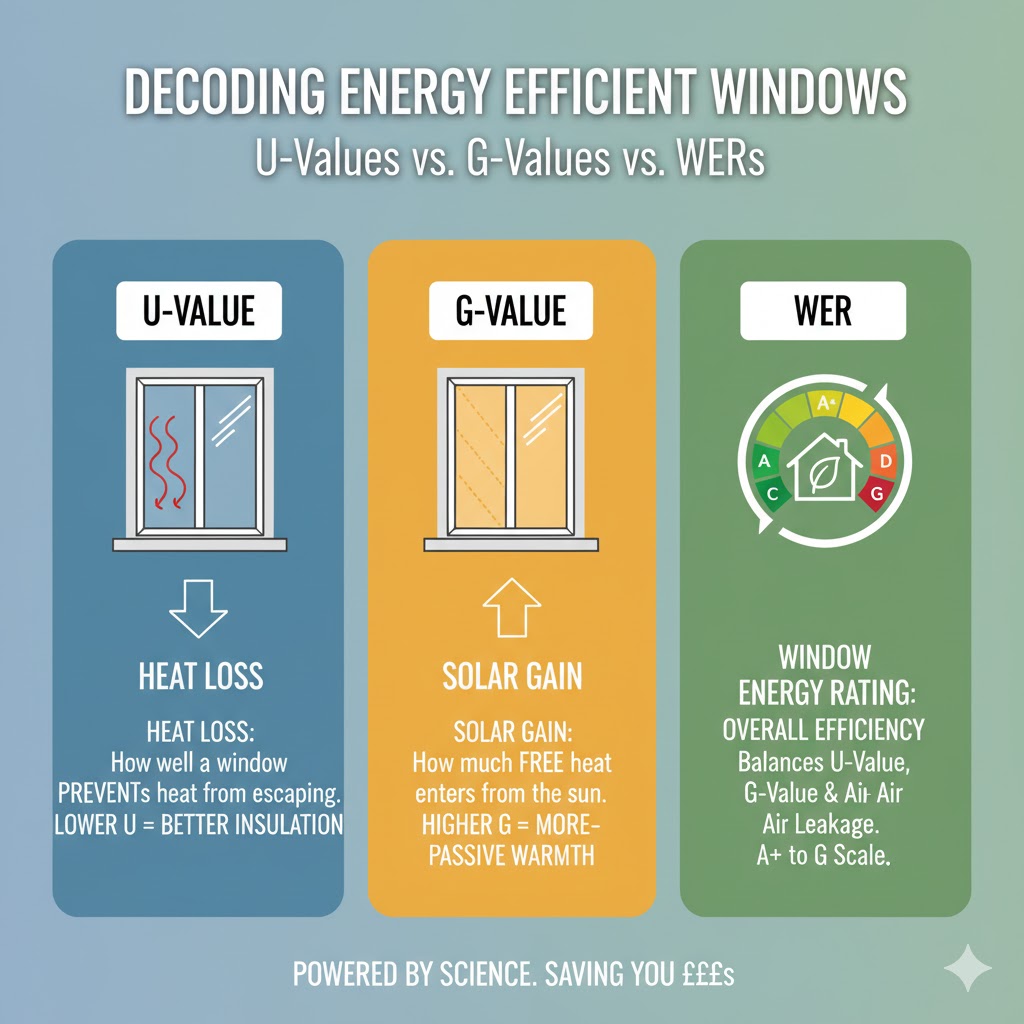
When comparing high-performance double or triple glazing, you will frequently encounter technical acronyms like U-values, G-values, and Window Energy Ratings. Understanding these terms is essential for selecting the right windows for your home. In short, U-values measure how effectively a window stops winter heat loss, while G-values measure how much free solar heat enters the room from the outside. The official BFRC Window Energy Rating combines these metrics into a simple A to G scale, making it easier for UK homeowners to compare overall thermal efficiency.
📉 U-Value (Insulation)
Measures overall heat loss. A lower number is always better (e.g., 0.8 is excellent, 1.4 is standard). This metric is governed by the Part L Building Regulations Gov.uk.
☀️ G-Value (Solar Gain)
Measures the free heat gathered from the sun. A high number is beneficial for winter heating, while a low number is necessary for preventing summer overheating.
🌈 WER (Energy Rating)
The consumer-friendly label (A++ to G) managed by the BFRC BFRC.org. It balances heat loss against free solar gain to provide one straightforward score.
Page Contents
If you have ever tried to compare high-performance windows, you have likely encountered a confusing array of acronyms. Installers frequently talk about WERs, architects specify U-values, and glass manufacturers mention G-values. It can be quite confusing.
Are they all measuring the same thing? Is a higher number better, or a lower one? The truth is, these architectural metrics often pull in opposite directions. A window that is excellent at keeping heat inside might actually be poor at releasing excess warmth during a hot summer.
1. The Big 3 Metrics Compared
Use this quick reference table to understand which specific number you should be prioritising based on your renovation goals.
| Metric | What it Measures | The Primary Goal | Best Suited For… |
|---|---|---|---|
| U-Value (Thermal Transmittance) |
Heat Loss. How fast your heating escapes through the material. | LOWER is Better. Aim for 1.2 W/m²K or lower. | Extensions, North-facing rooms, and keeping winter bills low. |
| G-Value (Solar Factor) |
Solar Gain. How much free sun heat safely enters the room. | Balance is Key. High for winter warmth, Low for summer cooling. | South-facing glass (requires Low G) or very cold rooms (High G). |
| WER (Window Energy Rating) |
Overall Efficiency. The balanced formula comparing heat loss to solar gain. | HIGHER is Better. Always aim for ‘A’ or ‘A+’. | Standard replacement windows where everyday simplicity is key. |
2. U-Values Explained (The Critical Detail)
The U-value is the most accurate, reliable measure of insulation. It clearly tells you: “If it is exactly 1 degree colder outside than inside, how much heat will escape through one square metre of this specific window?”
However, you should be careful when comparing quotes. There are two different types of U-value frequently quoted in the glazing industry, and they are not the same thing.
- Ug (Centre Pane): Strictly measures the performance of the glass only. This is usually a low, impressive number (e.g., 1.0).
- Uw (Whole Window): Measures the entire window unit, including the outer frame and internal spacer bars. This number is usually higher (worse) because plastic or timber frames naturally lose more heat than the high-tech glass.
3. G-Values: Free Heat vs. Overheating
The G-value is always expressed as a simple number between 0 and 1. A G-value of 0.75 effectively means that 75% of the sun’s natural heat enters the room.
The Architectural Conflict: In the UK winter, a high G-value is beneficial. It acts as free, natural heating (often termed Passive Solar Gain). However, in a well-insulated modern home featuring large expanses of south-facing glass (like aluminium bi-folds), a high G-value can lead to uncomfortable overheating in the summer, creating an unwanted greenhouse effect.
If you are planning to build a large south-facing extension or conservatory, you should ask your installer for Solar Control Glass (which possesses a low G-value) to ensure the room remains comfortable.
4. Window Energy Ratings (WER) Explained
The WER is the recognisable energy sticker officially managed by the BFRC (British Fenestration Rating Council). It combines the U-value, G-value, and air leakage (L-value) into one easy-to-read formula: (Solar Gain) minus (Thermal Heat Loss) minus (Air Leakage).
Because the formula credits you for beneficial Solar Gain, it is possible for a window with slightly poorer physical insulation (a worse U-value) to achieve an ‘A’ rating simply because it lets in a large amount of solar heat. This makes the WER perfect for quickly comparing standard residential windows, but slightly less useful for highly specialised, modern architectural projects where strict heat retention is required.
5. The Science: How Low-E Glass Works
How exactly can a transparent piece of glass actively stop heat? The secret is the Low Emissivity (Low-E) Coating.
This is a microscopically thin layer of metal oxide professionally applied directly to the inner surface of the glass pane during manufacturing. It acts as a highly selective thermal mirror:
- Short-Wave Radiation (Sunlight): Passes straight through the coating, naturally lighting and warming your living room.
- Long-Wave Radiation (Body Heat & Radiators): Bounces off the metal coating and is reflected back into the room.
At KJM Group, we exclusively utilise premium “Soft Coat” Low-E glass, which provides significantly better visual clarity and thermal performance than older “Hard Coat” versions (which historically often looked somewhat hazy).
6. The Future Homes Standard 2025
UK Building Regulations are steadily tightening. The highly anticipated Future Homes Standard Gov.uk aims to ensure new homes produce 75-80% fewer carbon emissions. To achieve this environmental goal, structural U-value targets are expected to drop drastically, likely moving towards 0.80 W/m²K for all new builds.
This demanding new standard is difficult for standard double glazing to meet, effectively paving the way for Triple Glazing to become the new national norm. Installing high-spec triple glazing today ensures your property remains compliant, valuable, and highly efficient for decades to come.
7. Frequently Asked Questions
No, displaying the physical rainbow sticker is voluntary for the manufacturer. However, the window must still legally meet the minimum energy efficiency standards (a minimum B-rating or a 1.4 U-value) required by modern UK Building Regulations, regardless of whether it explicitly has a label on it.
No. The scientific U-value exclusively measures heat loss. The ‘A’ rating (the WER) is often a better overall consumer score because it accounts for insulation plus the beneficial free heat naturally gained from the winter sun (the G-value).
Yes. The official rating securely applies to the whole window. Timber and modern uPVC are naturally excellent insulators. Because aluminium is naturally conductive (cold to the touch), modern premium aluminium windows must incorporate a specialised “thermal break” (a rigid plastic barrier deep inside the metal frame) to effectively stop heat transfer and achieve high energy ratings.
📚 Explore Our Performance Glazing Hub
This article is part of our comprehensive, fully transparent series on high-performance windows. Explore the full guides below:
Ready to Lower Your Energy Bills?
If you are looking to insulate your property and prepare for rising energy costs, we can expertly help. KJM Group installs high-performance, A-rated double and triple glazing entirely across Hampshire.
Contact KJM for a Free Quote
Mark Pearce is a highly experienced specialist in the double glazing industry, having built his knowledge from the ground up through hands-on experience in installation, manufacturing, sales, and business management. Beyond his role at KJM, Mark is a keen blogger, writer, and traveller, often sharing insights on the latest innovations in the home improvement industry.
- Pilkington Launches Optitherm S3 Plus Triple Glazing Glass - 16 October 2026
- Comp Door Launches New 2026 Brochure Featuring ‘Total Black Out’ Frames - 11 September 2026
- Solidor launch five new doors - 21 August 2026