Timber - PVC - Aluminium - Windows, Doors & Conservatories in Hampshire
The Efficiency Imperative: Is Your Front Door Leaking Money?
The Efficiency Imperative: Is Your Front Door Leaking Money?
Are you relentlessly losing expensive heat through an old timber door? We expertly explain the vital “Fabric First” energy rules, compare exactly how much cash escapes through old frames, and reveal why solid core composite doors are the ultimate winter upgrade.
As the UK aggressively navigates the ongoing cost-of-living crisis, maximizing home energy efficiency has explicitly transitioned from being merely a mild environmental concern to an absolute financial necessity. Consequently, installing high-quality energy saving doors in Hampshire properties is now widely considered one of the smartest, highest-ROI investments a homeowner can successfully make.
💷 The £4.1bn Leak
Older UK homes tragically lose expensive heat nearly 3x faster than our European neighbours. A heavily insulated solid core door successfully stops the hallway draft instantly.
🏠 Fabric First
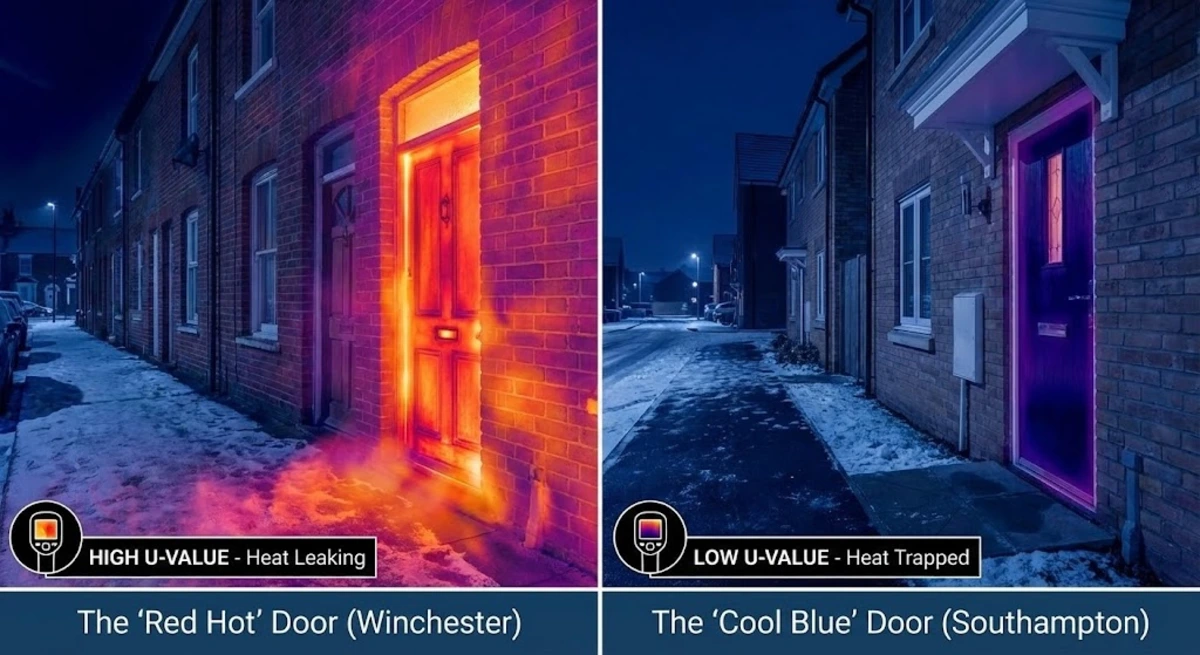
Insulation is absolutely key. A highly engineered modern composite door (U-Value ~1.4) effortlessly retains vital heat far better than old, warped timber (~3.0).
🛡️ Elite Security Standard
Beyond retaining thermal warmth, our premium composite doors heavily feature the renowned ABS 3-Star Diamond cylinder—which is officially virtually impossible to safely snap or drill.
Page Contents
1. The Great British Heat Leak
The aging UK housing stock is notoriously, incredibly inefficient. A recent massive nationwide study accurately revealed that when internal central heating is turned completely off, the average older UK household tragically loses internal heat at an alarming rate of 3°C in just five hours. In stark comparison, modern homes securely built in Germany lose a mere 1°C over the exact same period.
This definitively isn’t just a basic comfort issue; it is a genuinely massive economic leak. Extensive research heavily suggests the total annual cost saving from proactively replacing extremely old pre-2002 doors and windows nationally across the UK could remarkably reach a staggering £4.1 billion.
2. Interactive: Thermal Reality Check
Are you currently heavily debating exactly how much expensive heat your specific property is truly leaking? Use our highly interactive thermal diagnosis tool below to instantly find your precise heat loss severity.
🌡️ Thermal Leak Analyser
Answer 2 remarkably quick questions to accurately check your property’s thermal integrity.
What is the approximate overall age of your property?
What is currently installed in your main front doorway?
🚨 Heat Loss Status: CRITICAL
The Reality: Your older home is incredibly likely losing expensive heat roughly 3x faster than a modern building standard. You are effectively literally paying to aggressively heat the street outside.
The Smart Fix: Immediately upgrading your heavily warped timber or extremely thin uPVC door to a dense, solid-core composite door should absolutely be your #1 financial priority before ever considering expensive heat pumps.
Get a Quote for a Solid Core Door →⚠️ Heat Loss Status: MODERATE
The Reality: Your property is successfully performing slightly better than a totally uninsulated Victorian terrace, but you are unfortunately still actively leaking cash straight through the front entrance.
The Smart Fix: Successfully replacing heavily dated pre-2005 glazing and thin plastic doors with highly insulated modern A-rated units could effortlessly save you approximately £140-£170 every single year.
View Energy Saving Doors →✅ Heat Loss Status: EFFICIENT
The Reality: Excellent news. Your primary building fabric is highly secure. Because you already utilize a thermally dense composite door, you are successfully performing remarkably close to the strict Norwegian Standard (barely 0.9°C loss over 5 hours).
Next Steps: You are perfectly positioned and fully thermally ready to successfully explore highly advanced renewable heating solutions like heavy-duty Air Source Heat Pumps.
3. The “Fabric First” Hierarchy
In modern architecture, the heavily acclaimed “Fabric First” approach successfully provides the absolute definitive answer to high heating bills: you must rigorously prioritise the thermal performance of the physical building envelope (the exterior walls, modern windows, heavy doors, and the roof) before ever attempting to generate more internal heat.
4. The Renovation ROI Index
Ultimately, intelligently investing approximately £1,400 in a premium, heavily insulated composite front door that reliably lasts well over 35 years scientifically saves massively more total carbon than many highly publicised lifestyle changes simply by permanently reducing your heavy daily demand on the expensive national grid.
| Material Type | Typical U-Value | Thermal Efficiency Rating | Lifespan |
|---|---|---|---|
| High-Spec Solid Composite | ~0.8 W/m²K | Excellent (Strict Passivhaus Standard) | 35+ Years |
| Standard Modern Composite | ~1.4 W/m²K | Very Good (Exceeds Building Regs) | 35+ Years |
| Modern A-Rated uPVC | ~1.8 W/m²K | Good (Fully Compliant) | 20-25 Years |
| Solid Timber (Old/Warped) | ~3.0 W/m²K | Extremely Poor | Highly Variable |
5. The Brutal “Drafty Door” Experiment
On a freezing cold Hampshire night, modern thermal cameras visually reveal a truly stark, undeniable contrast. Older, heavily warped timber doors firmly installed in basic Victorian terraces glow a bright, aggressive red on the camera, explicitly visualizing incredibly expensive heat furiously bleeding directly from the warm hallway straight out into the freezing street.
6. The Lucrative EPC Effect
In highly competitive housing markets like Hampshire, an incredibly high EPC (Energy Performance Certificate) rating officially acts as a lucrative “Green Stamp of Approval” for potential buyers. Successfully upgrading terribly old timber doors to high-spec, heavily insulated composites is universally recognised as one of the absolute most highly effective ways to instantly bump your home’s total score up an entire band.
7. Frequently Asked Questions
The strict “Fabric First” approach absolutely prioritises the thermal performance of the outer building envelope (the masonry walls, modern windows, heavy doors, and the roof) long before ever installing expensive new heating systems. It successfully argues that massively insulating and tightly sealing the home to permanently reduce heat demand is vastly more cost-effective and highly sustainable than simply paying to generate more heat.
Extensive research officially indicates that highly inefficient windows and badly warped doors sadly account for approximately 20-30% of the total heat loss in a typical older UK home. Successfully replacing pre-2002 glazing entirely with modern A-rated units can brilliantly save you between £140 and £170 every single year according to the official Energy Saving Trust.
A specific U-Value meticulously measures exactly how easily internal heat physically passes directly through a solid material. Crucially, the remarkably lower the number, the significantly better the total insulation. An extremely old timber door might terribly have a U-Value of 3.0 W/m²K, whereas a highly engineered, premium composite door can beautifully be as low as 0.8 W/m²K, perfectly meeting strict Passivhaus standards.
Generally, yes, absolutely. While both are massive thermal improvements over rotting old timber, thick composite doors very often possess a vastly longer physical lifespan (35+ years vs roughly 20-25 years for basic standard uPVC) and feature far superior thermal density. Ultimately, this explicitly means they confidently save massively more carbon over their entire lifetime through significantly reduced daily heating requirements.
📚 The Composite Door Knowledge Hub
We strongly believe an educated customer logically makes the absolute best decisions. Explore our fully transparent buying guides below:
Ready to Stop Heating the Street?
Discover precisely how KJM Group can thoroughly support your complex door replacement needs. Whether you desperately require expert architectural advice on perfectly sourcing Solidor composites, or you are carefully exploring high-efficiency modern uPVC alternatives, we are here to definitely help.
Contact KJM for a Free Quote
Mark Pearce is a highly experienced specialist in the double glazing industry, having built his knowledge from the ground up through hands-on experience in installation, manufacturing, sales, and business management. Beyond his role at KJM, Mark is a keen blogger, writer, and traveller, often sharing insights on the latest innovations in the home improvement industry.
- Pilkington Launches Optitherm S3 Plus Triple Glazing Glass - 16 October 2026
- Comp Door Launches New 2026 Brochure Featuring ‘Total Black Out’ Frames - 11 September 2026
- Solidor launch five new doors - 21 August 2026