Timber - PVC - Aluminium - Windows, Doors & Conservatories in Hampshire
5 Ways to Clean and Maintain Your Composite Door
5 Ways to Clean and Maintain Your Composite Door
Composite doors are low maintenance, but they aren’t ‘no maintenance’. Here is exactly how to keep yours looking brand new.
- 🏠 The Cleaning Schedule: For standard residential areas, wipe down the door slab and clear the drainage channels every 3-4 months.
- 🌊 Coastal & Roadside Homes: If you live near the sea or a busy road, clean the door and hardware monthly to prevent salt and fume corrosion.
- ❌ The “Kill List”: Never, under any circumstances, use bleach, solvents (like nail polish remover), abrasive scouring pads, or high-pressure washers on the GRP skin.
- 🔧 Hardware Care: Lightly lubricate the hinges and multi-point lock hooks every 6 months to prevent the mechanism from stiffening or failing.
This guide is part of our comprehensive series on modern entrance doors. For a complete overview of materials, colours, and thermal performance, start with our main architectural guide: Composite Doors Explained.
You have invested in a premium composite door—a fantastic architectural choice for unbeatable security, timeless style, and excellent thermal efficiency. One of their biggest selling points over traditional timber is that they are incredibly “low maintenance”. But please remember: Low maintenance does not mean “No maintenance.”
Without basic, regular care, even the absolute highest quality composite doors (like the premium ranges we supply) can suffer from tarnished hardware, dried-out rubber seals, or a dull, faded finish caused by a buildup of traffic film. In this guide, we outline the exact 5-step process our installation teams recommend to keep your door looking brand new for its entire 35-year lifespan.
Page Contents
1. The Cleaning Schedule
How often you actually need to clean your door depends entirely on where you live. A door tucked away in a quiet suburban cul-de-sac needs far less rigorous care than one facing the driving winds of the Solent or the fumes of a busy main road.
| Frequency | Required Task | Who needs this? |
|---|---|---|
| Monthly | Quick wipe down with warm water to remove corrosive salt/grit. | Homes within 5 miles of the coast or directly on busy main roads. |
| Quarterly (3-4 Months) | Full soapy wash of the slab and outer frame. Polish the glass panels. | The standard recommendation for all residential homes. |
| Every 6 Months | Lubricate door hinges, key cylinder, and multi-point hooks. | Essential for everyone to prevent mechanical locking failure. |
| Annually | Check rubber weather seals for cracks. Clear the bottom drainage channels. | Essential to prevent internal water leaks and drafts during winter. |
2. The 5-Step Cleaning Process
You absolutely do not need expensive, specialised chemical cleaners. In fact, when it comes to the GRP (Glass Reinforced Plastic) skin of a composite door, simple is always better.
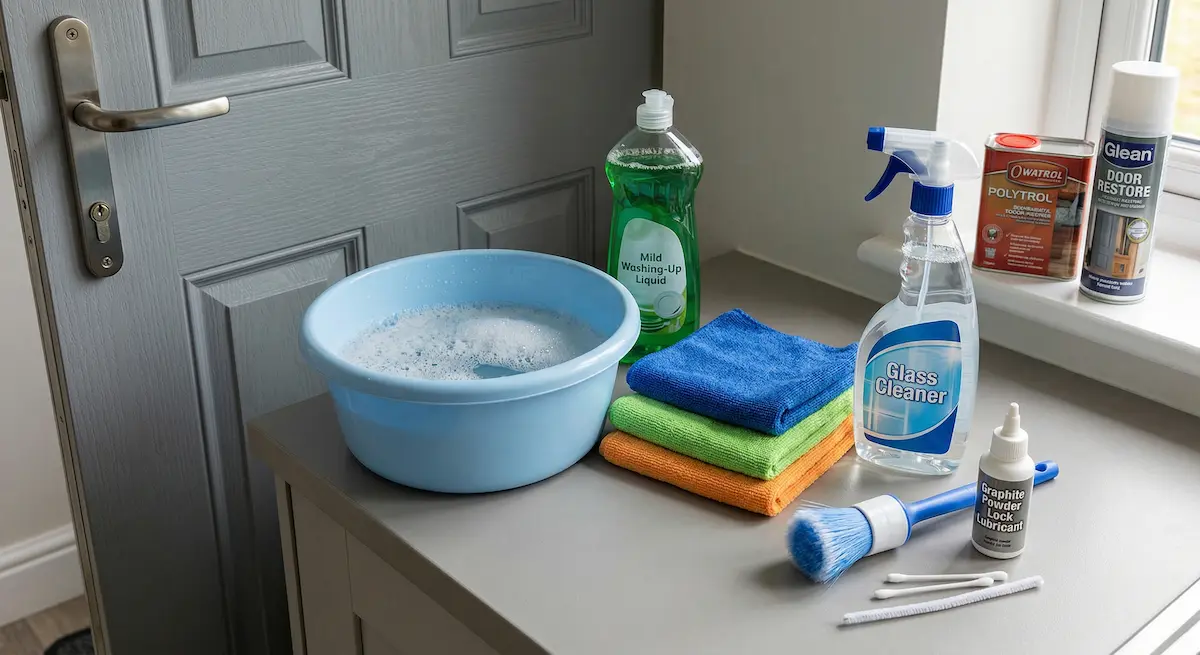
- Wash the Slab: Mix warm water with a mild, non-abrasive washing-up liquid. Use a soft microfibre cloth or a non-scratch sponge to gently wipe down the door leaf. Rinse thoroughly with clean water and dry it off to prevent water spots.
- Clean the Frame: Dirt, dead leaves, and grit often collect in the rebates (the internal “step” inside the frame). Open the door fully and wipe this area out completely to ensure a tight, draft-free weather seal.
- Glass Care: Use a standard household glass cleaner, but always spray it directly onto the cloth, not the door. This stops harsh glass-cleaning chemicals from running down the door and degrading the rubber seals or the GRP skin.
- Hardware Buff: Wipe handles, knockers, and letterboxes with a warm, damp cloth. Do not use metal polish (like Brasso) on gold or chrome-plated hardware, as the abrasive action will permanently strip the protective clear lacquer off.
- Drainage Check: Open the door and look closely at the bottom threshold frame. You will see small drainage slots. Use a pipe cleaner, a cotton bud, or a vacuum nozzle to clear out any mud or spiderwebs to stop rainwater backing up and overflowing into your hallway.
3. The Stain Buster Tool 🛠️
Sometimes, simple soapy water just isn’t enough to tackle accidental damage or wildlife. Use our interactive tool below to find the manufacturer-safe solution for removing stubborn marks without voiding your warranty.
Select Your Specific Stain:
🎨 Paint Splatter Solution
Do: Wait for it to dry, then gently pick off the raised lumps with your fingernail. For the remaining residue, use warm soapy water and a soft nylon brush (like an old toothbrush) to work it out of the woodgrain texture.
Don’t: Use white spirits, turps, or paint thinner! This will permanently melt and bleach the GRP skin.
🛢️ Grease, Oil & Fingerprint Solution
Do: Apply neat, undiluted washing-up liquid directly to the greasy spot. Leave it to break down the oils for 2-3 minutes, then wipe firmly with a very hot, damp microfibre cloth.
🐦 Bird Droppings Solution
Do: Soak the area immediately with a soaking wet sponge of warm water to soften the droppings. Do not scrape dry droppings, as birds consume small stones and the grit inside will heavily scratch the door. Wipe clean only once completely soft.
🏷️ Glue & Sticky Tape Residue Solution
Do: Soak the area with warm soapy water repeatedly to soften the adhesive. You can use a very small amount of WD40 applied to a rag (and rubbed only on the sticky spot) to dissolve the glue, but wash the area thoroughly with soap immediately after.
Don’t: Use nail varnish remover (Acetone)—it is highly corrosive and will instantly dissolve the door skin.
🖊️ Pen & Marker Solution
Do: Try an alcohol-free baby wipe first. If that fails, consult a professional cleaner. Permanent ink is incredibly difficult to remove from porous, textured GRP without causing permanent bleaching or damage.
4. What NOT to Use (The “Kill List”)
Using the wrong cleaning product is the #1 cause of manufacturer warranty claims being rejected. NEVER, under any circumstances, use the following on your composite door:
- Pressure Washers / Jet Washers: These are incredibly destructive. The high-pressure jet forces water deep into the timber core, damages the rubber weather seals, and physically strips the protective UV coating from the GRP skin.
- Abrasive Cleaners: Cream cleaners (like Cif), scouring pads, or wire wool will scratch the GRP skin instantly, leaving a dull, matte patch that cannot be repaired.
- Solvents & Bleach: White spirits, bleach, neat WD40 (sprayed directly on the skin), or nail varnish remover will permanently bleach the colour out of the door.
5. Mechanical Maintenance (Hinges & Seals)
A door that “sticks” or feels hard to lock often hasn’t actually failed mechanically—it simply needs adjustment. Composite doors are very heavy, and over time (due to gravity and seasonal thermal expansion) they can drop slightly in the frame.
If your door is physically catching on the bottom of the frame, or the lock hooks are hitting the metal keeps when you try to lift the handle, you likely need a Hinge Adjustment. Most modern composite doors feature 3D adjustable hinges. You can usually adjust these yourself with a 4mm or 5mm Allen key to lift the door back into perfect alignment. However, if you are unsure, contact your original installer for a service call.
The Paper Test (Checking Your Draft Seals)
Are you worried about winter drafts? Open the door, place a standard sheet of A4 paper against the rubber frame seal, and close the door on it. Now, try to pull the paper out. It should offer significant resistance or rip. If the paper slides out effortlessly, your compression seals (gaskets) may have flattened and need replacing, or the door hinges need adjusting to pull the slab tighter to the frame.
6. Restoring Faded Colour
Sometimes a simple wash isn’t enough. After years of heavy exposure to direct UV rays on south-facing elevations, the GRP skin can suffer from minor oxidation, leaving it looking dull, chalky, or milky. Do NOT use car wax to fix this, as the wax will dry white and get permanently stuck in the intricate woodgrain texture.
We recommend these two specific, industry-approved products to safely revive the original colour and shine of your door:
Owatrol Polytrol
A highly effective, deep-penetrating oil that safely revives the original colour and shine of plastics and GRP. Crucially, it does not form a surface film (so it won’t peel off like a varnish) and sinks deep into the pores, making it absolutely perfect for textured, wood-effect doors.
Glean Door Restore
A product specifically formulated and designed for the composite door industry. Available as an aerosol or liquid, it safely restores heavily faded colours on doors, window frames, and even composite decking, bringing back the original factory vibrancy.
7. Local Advice: High Exposure Areas
🏡 Regional Care Variations
Hampshire boasts a diverse mix of rural villages, urban towns, and coastal properties. Your exact location heavily dictates your required care regime:
- Coastal Properties (Southampton / Solent): Salt crystals carried in the sea air are incredibly corrosive to stainless steel hardware (handles, letterboxes, and hinges). If you live near the coast, you MUST wipe your hardware monthly with a damp cloth to prevent pitting and rusting (known as tea-staining).
- Hard Water Areas (Andover / Winchester): Our local water is chalky. When washing your door, ensure you dry it quickly with a microfibre cloth. Letting hard tap water dry naturally in the sun will leave stubborn white watermarks all over dark doors (like Black or Anthracite Grey).
8. Frequently Asked Questions
For the actual lock cylinder (the slot where the key goes), you must ONLY use Graphite Powder or a specialist dry PTFE lubricant spray. Never use wet oils like standard WD40 or 3-in-One inside the cylinder, as wet oil attracts dirt and dust, which forms a thick paste that will eventually jam the delicate pins. You can, however, use light machine oil on the external hinges and the metal locking hooks.
No. Magic Erasers are made of melamine foam, which acts as a microscopic sandpaper. While they are great at removing stains, they will physically abrade and dull the UV-protective layer on your composite door’s GRP skin, leading to premature fading.
Dark-coloured doors in direct sunlight absorb a massive amount of heat, causing the materials to naturally expand (thermal movement). To prevent this from causing permanent warping, you must ensure you engage the multi-point lock (firmly lift the handle upwards) every single time you shut the door. This mechanically holds the slab straight against the rigid frame as it cools down in the evening.
🚪 Composite Door Knowledge Hub
Keep your door looking and performing its best with our expert Spoke guides:
Is your door beyond repair?
If your door is severely faded, warped, or feeling insecure, no amount of cleaning will save it. Contact KJM Group today for advice or a free, no-obligation replacement quote across Hampshire, Berkshire, and Wiltshire.
Request a Replacement Quote
Mark Pearce is a highly experienced specialist in the double glazing industry, having built his knowledge from the ground up through hands-on experience in installation, manufacturing, sales, and business management. Beyond his role at KJM, Mark is a keen blogger, writer, and traveller, often sharing insights on the latest innovations in the home improvement industry.
- Comp Door Launches New 2026 Brochure Featuring ‘Total Black Out’ Frames - 11 September 2026
- Solidor launch five new doors - 21 August 2026
- KJM Group Wins Which? Trusted Trader of the Month (Aug 2026) - 4 August 2026