Timber - PVC - Aluminium - Windows, Doors & Conservatories in Hampshire
Part Q: What it means for your home extension
Part Q: What it means for your home extension
Confused by Approved Document Q? Our guide explains PAS 24 security regulations for new builds vs. extensions in Hampshire and what you legally need to install.
- 📜 The Rule: Part Q (Security) of the Building Regulations is legally mandatory for all New Build Homes and Change of Use properties (e.g., barn conversions).
- 🏗️ Extensions: While understanding the building regulations for windows in an extension is vital, Part Q is NOT currently mandatory for standard extensions, but it is highly recommended.
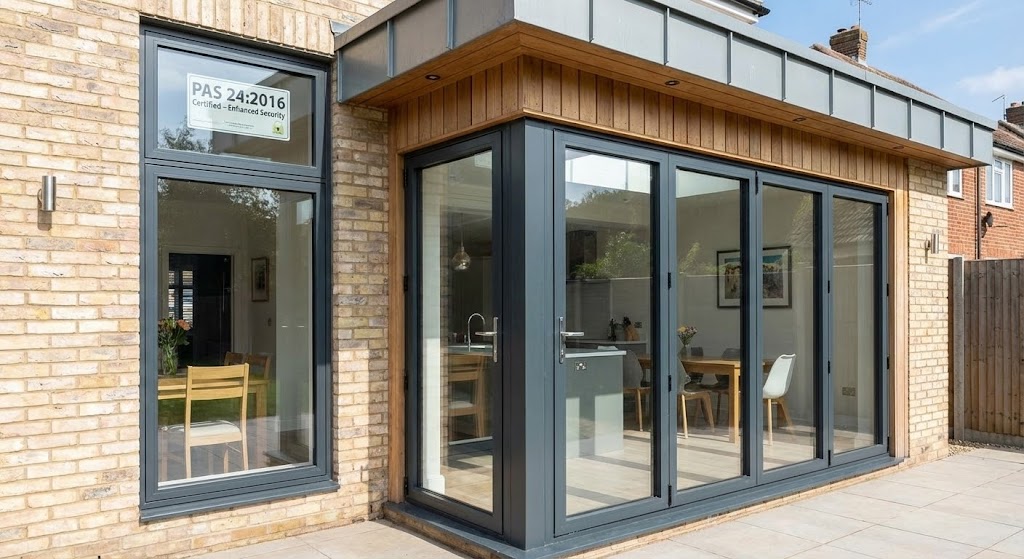
- 🛡️ The Standard: If you are wondering “do I need PAS 24 windows,” the answer is yes for new builds. To achieve Part Q compliance, windows and doors must successfully pass rigorous independent PAS 24 physical security testing.
Building a new extension or constructing a brand new home is an incredibly exciting process, but navigating the maze of UK Building Control paperwork can be overwhelming. One specific regulation that frequently catches homeowners and architects out is Approved Document Q (Security).
Introduced in 2015, Part Q was explicitly designed to ensure new homes are built robustly enough to resist opportunistic intruders. But does this strict law apply if you are just building a standard kitchen extension? At KJM Group, we believe you should know exactly what you are paying for—and understand why opting for “optional” security is usually the smartest long-term choice for your property.
Page Contents
1. What is Approved Document Q?
Approved Document Q is a specific section of the UK Building Regulations that legally dictates “Security in Dwellings.” It mandates that all easily accessible windows and doors (such as those on the ground floor, basement level, or accessible via a flat roof or balcony) must be robustly manufactured to resist physical attack by a burglar.
To achieve full Part Q compliance, your newly installed windows and doors must be independently tested to the PAS 24 standard. This involves certified laboratories physically attacking the window with crowbars, cutting tools, and heavy impact rams. If the window or door survives the assault for a set period of time without allowing entry, it passes.
2. Does it Apply to Me? (The Legal Rules)
This is the most common source of confusion we encounter at KJM. The rules differ significantly depending on whether you are building a brand new house from scratch, or simply adding to an existing one.
Do I Legally Need Part Q?
🏠 New Build Home
Requirement: MANDATORY
Scope: Every single accessible window and door on the property must legally comply with Part Q to receive building control sign-off.
🚜 Conversion (e.g. Barn)
Requirement: MANDATORY
Scope: Any official “Change of Use” that turns an existing non-residential building into a dwelling automatically triggers Part Q compliance.
🧱 Extension / Replacement
Requirement: OPTIONAL
Scope: When reviewing the building regulations for windows in an extension, Part Q is technically not retrospective. You are not legally forced to use PAS 24 windows, though many architects specify it anyway.
3. The Specs: What Makes a Window “Part Q”?
To the naked eye, a standard double-glazed window might look exactly the same as a Part Q compliant one, but physically and structurally, they are vastly different. To achieve the stringent PAS 24 standard required by Part Q, the unit typically features:
- P1A Laminated Glass: At least one pane of the double-glazed unit must be laminated (much like a car windscreen). If a burglar strikes it with a hammer, it physically holds together rather than shattering into pieces, denying them entry.
- Security Glazing Clips: The glass must be structurally bonded or internally clipped to the frame so an intruder cannot simply pop the glass pane out from the outside.
- Key Locking Handles: All accessible openings must feature robust, key-lockable handles.
- Reinforced Meeting Rails: On French doors or dual-sash windows, the central meeting point must be heavily reinforced to prevent someone from jemmying them apart with a crowbar.
4. The Hampshire Extension Dilemma
🏡 Should I upgrade my extension anyway?
As a local installer serving Andover, Winchester, and Basingstoke, we frequently speak to homeowners who realize that Part Q is “optional” for their new kitchen extension and ask if they should bother paying for the upgrade.
Our answer is almost always Yes. Burglars target the weakest point of a property. If you have a highly secure composite front door, but install cheap, non-PAS 24 compliant French doors on the rear of your new extension, you have provided an easy entry point. We highly recommend specifying PAS 24 windows for all ground-floor projects to ensure your home insurance remains valid and your family stays safe.
5. Official Government Downloads
For full technical details, you can download the official government Approved Documents below to see exactly what building control inspectors look for.
📄 The Merged Approved Documents (Oct 2024)
This is the definitive UK government guide containing Part Q (Security) alongside other recent critical building regulation updates.
📥 Download PDF (Gov.uk)6. Frequently Asked Questions
Currently, no. Part Q generally only applies to new build properties and dwellings created by a formal change of use (like a barn conversion). However, many architects and homeowners actively choose to specify PAS 24 compliant windows for extensions anyway for peace of mind and enhanced security.
Generally, no, unless they are classed as “easily accessible.” This means if a burglar can easily climb onto a flat extension roof or a balcony to reach the first-floor window, it MUST be Part Q compliant. If it is a standard vertical wall drop, it is exempt.
Not quite. Part Q is the minimum legal requirement set by building regulations. Secured by Design (SBD) is a much higher, official Police standard. However, most products that achieve the SBD standard are automatically Part Q compliant.
Yes. If KJM installs windows that are required to be Part Q compliant (e.g., for a new build or conversion), we provide all the necessary technical paperwork to prove the products meet PAS 24 standards. You pass this directly to your Building Control Officer to achieve your final completion certificate.
📚 Related Security & Regulation Guides
Ensure your home renovation is legally compliant and totally secure:
Planning a new extension or build?
Don’t risk failing your building control inspection. Contact KJM Group today for expert advice and a free quote on fully Part Q / PAS 24 compliant glazing across Hampshire, Berkshire, and Wiltshire.
Request a Compliant Glazing Quote
Mark Pearce is a highly experienced specialist in the double glazing industry, having built his knowledge from the ground up through hands-on experience in installation, manufacturing, sales, and business management. Beyond his role at KJM, Mark is a keen blogger, writer, and traveller, often sharing insights on the latest innovations in the home improvement industry.
- Pilkington Launches Optitherm S3 Plus Triple Glazing Glass - 16 October 2026
- Comp Door Launches New 2026 Brochure Featuring ‘Total Black Out’ Frames - 11 September 2026
- Solidor launch five new doors - 21 August 2026