Timber - PVC - Aluminium - Windows, Doors & Conservatories in Hampshire
Softwood vs. Hardwood Windows & Doors: The Ultimate Buyer’s Guide
Softwood vs. Hardwood Windows & Doors: The Ultimate Buyer’s Guide
A comprehensive buyer’s guide to navigating Sapele, Oak, Redwood, and Accoya. Discover which timber provides the ultimate durability for your home.
- 🌲 The Core Difference: “Hardwood” and “Softwood” are botanical classifications. While traditional hardwoods (like Oak) are incredibly dense, modern engineered softwoods now offer fantastic structural stability.
- 💷 Investment Value: Timber windows generally cost roughly three times the price of uPVC, but they justify this with a superior lifespan of 60+ years and significantly enhanced property resale value.
- ✨ Modern Finishes: Forget annual sanding. Modern microporous paints allow the timber to breathe, meaning you only need to re-stain or paint every 8–10 years.
- 🏆 The Ultimate Timber: Accoya (a modified softwood) currently dominates the premium market, offering a 50-year guarantee against rot and exceptional thermal efficiency.
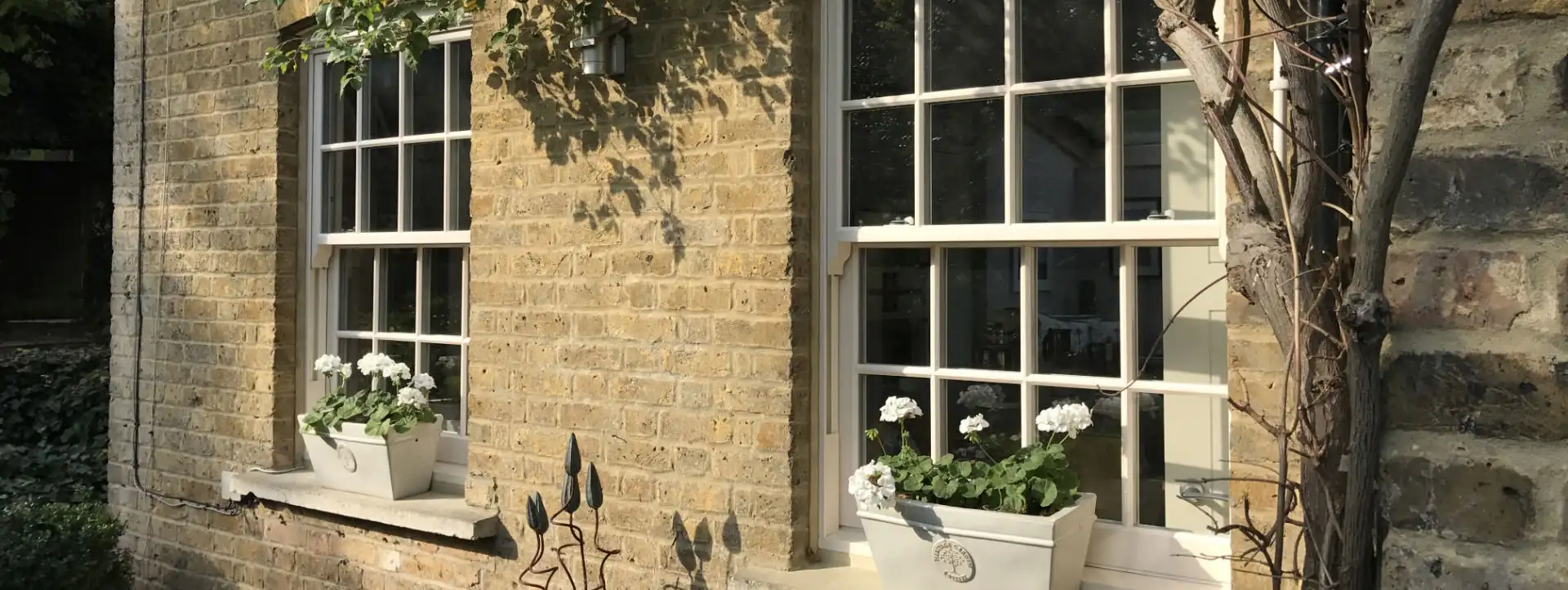
Hardwood, softwood, engineered timber, or modified wood? When replacing your windows, the choice of materials can quickly become overwhelming. While undeniably more expensive than uPVC or aluminium, genuine timber windows justify their initial cost with superior longevity (60+ years) and an unmatched architectural character that completely transforms a property.
In this guide, KJM Group explains the science behind the wood, the varying costs, the maintenance realities, and the aesthetics to help you make the correct investment for your home.
Page Contents
1. Interactive: Timber Assessor
1. What is your primary goal for these windows?
2. How do you feel about repainting them?
🏆 Recommendation
2. The Core Difference: Biology vs. Terminology
The terms “Hardwood” and “Softwood” are actually botanical definitions, not direct descriptions of physical density. For example, Balsa wood is technically classified as a hardwood despite being incredibly soft! The true distinction lies deep within the cellular structure of the tree.
🌲 Gymnosperms vs. Angiosperms
- Hardwoods (Angiosperms): These are deciduous trees (e.g., Oak). They feature a complex cellular structure with four distinct cell types, making them naturally denser and highly durable. They are the ideal choice for Listed Buildings.
- Softwoods (Gymnosperms): These are conifers and evergreens (e.g., Pine or Redwood). They possess a much simpler structure with only two cell types. Because they grow significantly faster, they are highly sustainable and generally more affordable.
3. Quick Comparison: Lifespan & Cost
While timber windows generally cost roughly three times the price of uPVC, their operational lifespan is vastly superior. A well-maintained hardwood or modified softwood window can comfortably outlast two or three generations of plastic frames.
| Timber Type | Est. Lifespan | Cost Ratio | Best For |
|---|---|---|---|
| Standard Softwood (Pine) | 20 – 30 Years | Lowest (£) | Budget-conscious renovations |
| Engineered Redwood | 30 – 40 Years | Medium (££) | Modern homes & painted finishes |
| Hardwood (Oak/Sapele) | 40 – 60+ Years | High (£££) | Heritage & Listed properties |
| Accoya (Modified) | 50 – 80+ Years | Premium (££££) | Ultimate performance & low maintenance |
4. The Sustainability Factor
One of the primary reasons homeowners are switching back to timber is its drastically lower environmental impact. Unlike uPVC, which requires significant industrial energy to produce and relies heavily on fossil fuels, timber is completely carbon-negative.
- Carbon Capture: Trees absorb CO2 as they grow. When the wood is harvested and utilized in your windows, that carbon remains completely “locked in” for the entire lifetime of the product.
- Renewable Sourcing: KJM Group only sources timber from strictly FSC-certified forests, ensuring that more trees are planted than are harvested.
- Fully Biodegradable: At the very end of its long life, timber is fully biodegradable or recyclable, whereas plastic contributes directly to global landfill issues.
5. The Best Timbers for Windows & Doors
We work with four distinct categories of timber, each perfectly suited to different budgets and architectural styles.
1. Sapele (Hardwood)
Sustainably sourced from West Africa, Sapele is our most popular traditional hardwood. It features a stunning dark reddish-brown hue that looks absolutely incredible under transparent stains.
- Durability: Class 3-4 (Naturally resistant to rot).
- Maintenance: Requires re-staining every 3-5 years depending on weather exposure.
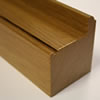
2. European Oak (Hardwood)
The absolute traditionalist’s choice. Used reliably for centuries, Oak is incredibly dense and immensely strong. However, because it is slow-growing, it commands a premium price.
- Strength: High 720 kg/m² structural density.
- Warning: Oak tannins can chemically react with standard steel fixings; it must be installed using specialist marine-grade stainless steel hardware.
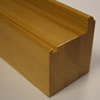
3. Engineered Redwood (Softwood)
Manufacturers create engineered timber by securely bonding opposing wood strands with industrial adhesives, resulting in a material that is structurally far more stable than solid, single-piece softwood.
- Knot-Free: It expertly prevents natural tree resins from bleeding through and ruining crisp white paint finishes.
- Stability: Vigorously resists twisting and warping during seasonal humidity changes.
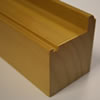
4. Accoya (Modified Softwood)
Accoya is the industry’s modern “super-wood.” Utilizing a non-toxic acetylation process, the timber’s cellular structure is permanently altered to completely stop it from absorbing water.
- The Guarantee: A massive 50-year guarantee against rot above ground.
- Thermal Efficiency: Retains 40% better thermal insulation than traditional hardwood.
- Paint Retention: Because the wood never swells or shrinks, paint finishes can last up to 12 years without cracking.
6. Modern Finishes: Why They Don’t Peel
Many homeowners clearly remember the grueling old days of heavily sanding and repainting wooden windows every single summer. Fortunately, modern chemical technology has changed that completely.
We exclusively utilize microporous paints and stains. This advanced technology functions similarly to GORE-TEX fabric:
- Water Resistance: It creates a tight barrier that actively stops rain from penetrating the wood from the outside.
- Breathability: Crucially, it allows any natural internal moisture within the wood to safely escape as a breathable vapor.
Historical oil-based paints fatally trapped moisture inside the frame, causing the wood to quietly rot and the paint to visibly blister. Modern finishes flex naturally with the wood, entirely preventing this and extending your maintenance intervals to 8-10 years.
7. Repair vs. Replace: The Timber Advantage
One of the massive financial benefits of authentic timber is that it is fundamentally repairable. If a welded uPVC window frame cracks or snaps, the entire unit usually requires complete replacement. With timber, a skilled carpenter has numerous repair options.
⚠️ When is it time to replace?
If you observe extensive rot (the wood is highly crumbly in multiple structural places) or severe structural warping (the opening sash no longer fits the outer frame), full replacement is almost always more cost-effective and secure than attempting a repair.
Common Timber Issues & Simple Fixes
- Sticking Sashes: Frequently caused by thick paint buildup or minor moisture swelling. The Fix: Lightly sanding down the friction areas and applying a protective wax.
- Draughts & Rattles: Older heritage windows completely lack modern seals. The Fix: Professionally installing modern weatherstripping or Secondary Glazing can instantly improve energy efficiency.
8. Frequently Asked Questions
Not necessarily. While traditional hardwoods like Oak are much denser, modern modified softwoods like Accoya actually vastly outperform traditional hardwoods regarding dimensional stability, thermal insulation, and overall longevity.
Modern microporous paints allow the wood to safely breathe, meaning finishes last significantly longer than in the past. Typically, you should expect to lightly repaint or restain standard timber every 5-8 years. However, Accoya frames hold paint so well they often last 10-12 years between coats.
Absolutely. Modern timber windows manufactured today are internally beaded (meaning the glass cannot be removed from the outside) and are fitted with advanced steel multi-point locking systems, performing exactly like high-security composite or uPVC frames.
📚 Explore Our Timber Knowledge Hub
You understand the materials, now explore the products specifically designed for heritage and high-end homes:
See the Quality for Yourself
The absolute best way to decide is to physically feel the grain and see the microporous finishes in person. Visit the KJM Group showroom in Andover to view our full range of Sapele, Oak, and Accoya products, or contact us for a transparent, no-obligation quote.
Request a Transparent Quote
Mark Pearce is a highly experienced specialist in the double glazing industry, having built his knowledge from the ground up through hands-on experience in installation, manufacturing, sales, and business management. Beyond his role at KJM, Mark is a keen blogger, writer, and traveller, often sharing insights on the latest innovations in the home improvement industry.
- Comp Door Launches New 2026 Brochure Featuring ‘Total Black Out’ Frames - 11 September 2026
- Solidor launch five new doors - 21 August 2026
- KJM Group Wins Which? Trusted Trader of the Month (Aug 2026) - 4 August 2026