Timber - PVC - Aluminium - Windows, Doors & Conservatories in Hampshire
Child safety – falls from windows
Child safety – falls from windows
Protect your family from falls without compromising fire safety. Discover how cable restrictors and the 100mm building regulation rule keep your home secure.
- 📉 The Risk: Over 4,000 children under the age of 15 are severely injured falling from windows in the UK every single year (Source: RoSPA).
- 🪟 The Fix: Strong window restrictors for children mechanically limit the window opening to a safe distance (100mm) while still allowing vital fresh air ventilation.
- 🔥 The Crucial Balance: You must ensure restrictors can be released by an adult in an emergency. Trapping a child in a room during a house fire is incredibly dangerous.
- 🏡 Retrofit Ready: You don’t need to buy brand new windows; we can securely fit child safety window locks to almost any existing uPVC, timber, or aluminium frame.
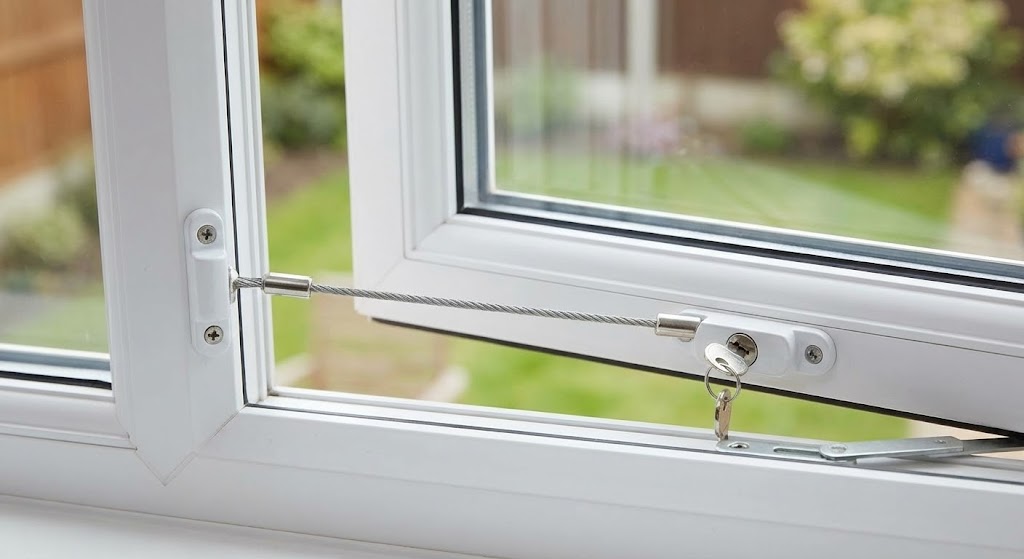
The figures speak for themselves. According to the Royal Society for the Prevention of Accidents (RoSPA) External, falls from upper-storey windows present a significant, life-threatening risk. If you find yourself asking how to stop a child falling out a window, you are not alone; it is a primary concern for parents, especially during the hot summer months when windows are frequently left wide open for ventilation.
But it is not just about toddlers and children. The Health and Safety Executive (HSE) also highlights increasing fall risks for vulnerable adults, particularly in residential care settings. Whether you are a parent, a private landlord, or a care home manager, securing your windows is both a strict legal duty and a moral priority.
Page Contents
1. How to Stop a Child Falling Out a Window (The 100mm Rule)
The most effective, reliable way to prevent tragic accidents is to install robust window restrictors for children. These mechanical devices physically limit how far a window sash can open, preventing a child from squeezing through while still letting fresh air into the room.
When searching for the correct child safety window locks UK Building Regulations provide a clear benchmark. Why do almost all approved restrictors stop the window opening at precisely 10cm?
The strict rule of thumb (formally cited in Approved Document K regarding protection from falling) is that a solid sphere of 100mm diameter should not be able to pass through any gap in a barrier. This 100mm dimension accurately represents the size of a small child’s head. The logic is simple: if the head cannot pass through the gap, the torso and body will not be able to follow.
Modern, high-quality restrictors are built to withstand significant physical force. A compliant restrictor is tested to hold securely against forces of 500N (approximately 50kg) or more. This means that even if an older child stumbles and falls their full weight against the open window, the restrictor will hold the sash firmly in place.
2. The Vital Balance: Child Safety vs. Fire Escapes
Whilst preventing falls is absolutely vital, locking a child inside a bedroom with no possible means of escape during a house fire is incredibly dangerous. Under UK Building Regulations (Part B – Fire Safety), all habitable rooms situated above ground level must have a designated, unobstructed fire escape window (known as an egress window).
If you fit a strict key-locking restrictor to an egress window, the key MUST be kept permanently adjacent to the window—safely out of reach of toddlers, but easily and immediately accessible to adults and older children who know how to unlock it in a panic. Alternatively, use a push-to-release mechanism that an adult can bypass instantly without hunting for a key through thick smoke.
3. Cable vs. Hook & Eye vs. Integral Restrictors
There are several types of restrictors available on the market today. Which one you choose depends entirely on whether you are retrofitting existing windows, managing a heritage timber property, or buying brand new uPVC frames.
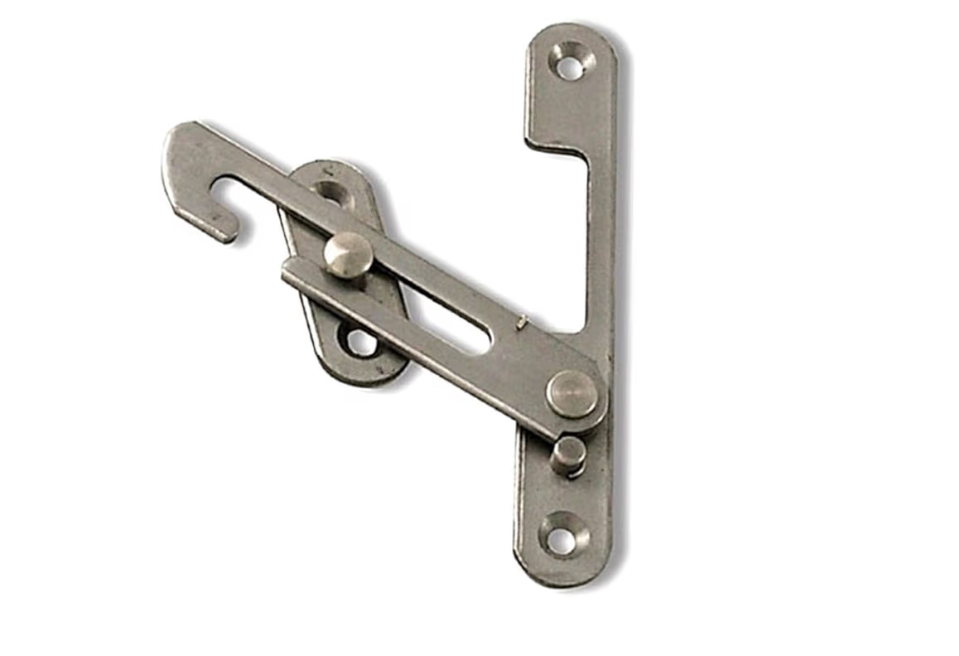
| Restrictor Type | How it Works | Best Used For… |
|---|---|---|
| Cable Restrictor | A highly visible, PVC-coated steel cable securely connects the opening sash directly to the outer frame. Usually key-operated. | Retrofitting. Excellent for existing uPVC or aluminium windows. Very strong and highly visible, providing peace of mind. |
| Integral Hinge | Built invisibly inside the friction hinge mechanism itself. It engages automatically when the window is opened. | New Installations. Usually fitted at the factory when manufacturing brand new windows. Offers a perfectly clean aesthetic. |
| Hook & Eye | A traditional metal arm drops over a fixed peg to hold the window open at a set distance. Usually push-to-release. | Heritage Timber. Perfect for older, period properties where installing modern plastic cables would ruin the historic character. |
4. Commercial Duty: Care Homes & Hampshire Landlords
🏢 Local Liability & Compliance
If you rent out a property across Andover, Winchester, or Southampton, you have a strict legal duty of care under the Housing Health and Safety Rating System (HHSRS). If an upper-storey window has a low sill height (less than 800mm from the floor level), it is officially classed as a ‘Fall Hazard’. Installing restrictors is a low-cost way to ensure your tenants’ safety and severely limit your legal liability.
For Care Homes and Hospitals, standard domestic restrictors are not enough. We supply and fit heavy-duty commercial restrictors that are completely “Tamper Proof” (they cannot be released without a specialist tool held only by ward staff) and are permanently fixed deep into the internal steel reinforcement of the window profile.
5. Frequently Asked Questions
Yes. Cable restrictors are universally compatible. They can be screwed securely into uPVC, Timber, or Aluminium frames. KJM Group can supply and professionally fit these for you to ensure they are anchored deep into the internal reinforcement of the frame, rather than just the superficial outer plastic.
While the fatal fall risk is obviously much lower, restrictors on ground-floor windows are absolutely excellent for home security. They allow you to leave the window safely open for summer ventilation without opening it wide enough for an opportunistic intruder to climb in or reach through to steal keys.
Not always. While many standard window locking handles use a generic “cut,” aftermarket cable restrictors often have their own specific, unique keys. We strongly recommend keeping all relevant window keys permanently located in a known, safe place adjacent to the window to ensure a rapid escape in case of fire.
📚 Explore Our Safety & Security Hub
Ensure your home is safe, secure, and compliant with our other expert guides:
Need to secure your windows?
Don’t leave your family’s safety to chance with faulty or missing restrictors. Contact KJM Group today for expert advice and professional installation of child safety restrictors across Hampshire, Berkshire, and Wiltshire.
Request a Safety Audit Quote
Mark Pearce is a highly experienced specialist in the double glazing industry, having built his knowledge from the ground up through hands-on experience in installation, manufacturing, sales, and business management. Beyond his role at KJM, Mark is a keen blogger, writer, and traveller, often sharing insights on the latest innovations in the home improvement industry.
- Pilkington Launches Optitherm S3 Plus Triple Glazing Glass - 16 October 2026
- Comp Door Launches New 2026 Brochure Featuring ‘Total Black Out’ Frames - 11 September 2026
- Solidor launch five new doors - 21 August 2026